

Hypnotherapy for Anxiety

Why does your body react like something's wrong when nothing is?
You're sat at your desk, or on the sofa, or lying in bed, and your chest is tight, your stomach's churning and your head is already three steps ahead, running through everything that could go wrong.
Nothing has happened.
You know nothing has happened.
Your body hasn't caught up with that yet.
Hypnotherapy for anxiety works with the part of your brain that's doing this.
We calm the alarm system underneath the thoughts, which gives the thoughts far less to feed on.
I'm Emma Fogg, an award winning Solution Focused hypnotherapist and I work online with people across the UK and worldwide who are tired of feeling on edge.
If you're struggling with a specific form of anxiety, such as health anxiety or social anxiety, I have a page for each.
—————————————————————
Anxiety can feel like your mind and body are constantly on alert.
Anxiety rarely announces itself as anxiety. More often it looks like this:
Waking at 4am with your heart going before you've even remembered what you're worried about.
Rehearsing a phone call five times before you make it.
Getting a message that says "can we have a quick chat?" and losing the whole afternoon to it.
Cancelling plans you were looking forward to, then feeling rubbish for cancelling.
A tight chest, a churning stomach, or a jaw you didn't realise you were clenching.
A low hum of nervousness that never switches off, even on holiday.
Snapping at the people you love because there's nothing left in the tank.
Even when everything appears fine on the outside, inside you may feel tense, restless or unable to fully relax.
Thoughts might race ahead to worst-case scenarios, or your body may respond with unease, a tight chest, shallow breathing, an unsettled stomach, or a quiet sense that something isn’t quite right.
For many people, anxiety doesn’t arrive with a clear cause.
It can build gradually over time, becoming part of everyday life until you realise it’s affecting your sleep, confidence, focus or enjoyment of things you once found easy.
If you've lived like this for a while, it can start to feel like your personality.
It's a pattern your brain has learned and patterns can change.
Why anxiety happens: meet your caveman brain
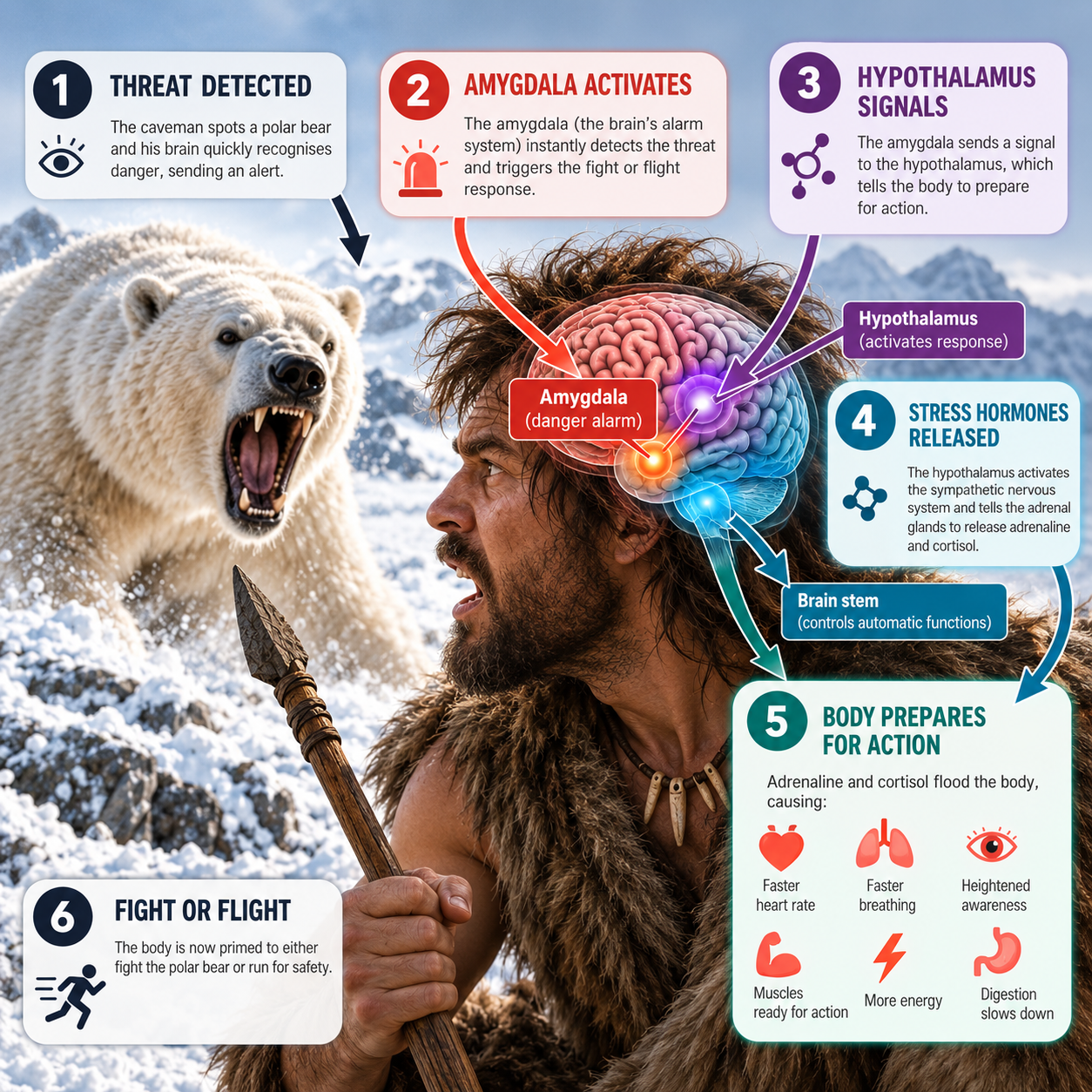
Deep in your brain is a very old part I call the caveman brain.
It has one job, which is to keep you alive.
When it spots danger it floods you with adrenaline and cortisol so you can fight or run.
Picture a polar bear walking into the room.
Your heart races, your breathing goes shallow, your digestion shuts down and your thinking narrows to one thing.
That's exactly the right response to a polar bear.
The trouble is that the caveman brain can't tell a polar bear from an inbox with 47 unread emails.
Or a funny noise from the car.
Or the thought of walking into a party where you won't know anyone.
Real threat or imagined threat, it reacts the same way.
Then there's what I call the stress bucket.
Every worry, every bad night's sleep and every niggle you haven't dealt with goes into it.
We empty it naturally during REM sleep, the dreaming part of the night.
When the bucket is filling faster than your sleep can empty it, it overflows, and the caveman brain ends up in charge more and more of the time.
That's why anxiety can arrive for no reason you can point to.
There usually is a reason.
It's the bucket.
Clients tell me this explanation, in the very first session, is the thing they wish someone had told them years ago.
Once you understand what your brain is doing, it gets a lot less frightening.
Anxiety comes in different shapes
Anxiety is a broad word. These are the forms I see most often, with a page on each if you'd like more detail.
-
A background hum of worry that moves from one subject to the next. When one thing is sorted, something else steps in to take its place. Many people I see have been told they have generalised anxiety, and many more have never had a label and just know they've felt this way for years.
-
Shaky hands before a presentation, a dry mouth before a meeting, feeling sick before a driving test, an exam or a first date. Nerves are anxiety with a specific target, and they often respond quickly because we know exactly what we're working towards.
-
Sudden waves of fear with a pounding heart, tight chest and the feeling something terrible is about to happen. There's a full page on hypnotherapy for panic attacks.
-
Checking your body, googling symptoms, and needing reassurance that only lasts a few hours. There's a full page on hypnotherapy for health anxiety.
-
Dreading rooms full of people and replaying conversations for days afterwards. There's a full page on hypnotherapy for social anxiety.
-
A mind that won't switch off, especially at night. There's a full page on hypnotherapy for overthinking.
-
Running on empty, still not switching off, and wondering when you stopped enjoying things. There's a full page on hypnotherapy for stress and burnout.
-
Flying, driving, needles, the dentist. Anxiety pinned to one specific thing. Each has its own page under Fears and Phobias.
If you've already tried the NHS route…
A lot of the people who come to me have already been through NHS Talking Therapies.
Some waited the best part of a year for a handful of sessions.
Some found group CBT useful.
Others found it didn't go deep enough for them, or that their GP moved straight to medication when what they wanted was someone to talk to.
The thing I hear most is that nobody ever explained how their brain works.
That's where we start.
Hypnotherapy works alongside anything your GP has suggested, including medication.
Please don't stop or change anything you've been prescribed without speaking to them first.
Does hypnotherapy work for anxiety?
Here's what the evidence says, without dressing it up.
A 2019 review of the clinical trials, published in the International Journal of Clinical and Experimental Hypnosis, found that people who had hypnosis reported lower anxiety than people who didn't.
Anxiety UK, the national charity, offers clinical hypnotherapy as one of its therapy services.
How hypnotherapy helps anxiety
Each session has two halves.
In the first half we talk. Solution Focused Hypnotherapy looks forward, so rather than digging through your past, we look at what you want life to feel like and what's already going a bit better than you'd noticed. That might sound soft. It's the bit doing the heavy lifting, because a brain aimed at something it wants behaves very differently to a brain that's only ever scanning for threats.
In the second half you relax into hypnosis. Hypnosis is a focused, deeply relaxed state you already drift into on your own, like driving a familiar route and not remembering the last few junctions. In that state the busy, analytical part of your mind settles, and the calmer, more rational part of your brain gets a chance to take back the controls.
The idea behind Solution Focused Hypnotherapy is that trance helps empty the stress bucket in a similar way to REM sleep. Most people notice they're sleeping better within the first few weeks, which tends to help everything else.
Most of my work is Solution Focused. Where it helps, I'll bring in other techniques too.